
Every purchase begins with the same kind of sentence, usually spoken by someone who has never read the procurement policy. “We need to renew a critical technology contract worth £250,000, but the supplier has already sent the renewal terms directly to the business”.
I have long believed that what happens in the next few minutes decides whether that spend is governed or not. In most organisations, nobody in finance can see those minutes at all. That is why I believe procurement intake is the most important control point a CFO is not yet managing.
The problem is not the policy, it is the doorway
Most organisations I speak to have a sound procurement policy. It sets thresholds, defines when three quotes or a tender are required and has been signed off by the board. The difficulty is that the policy lives in a document, while the people who need to follow it live in their inboxes, their budgets and their deadlines.
Too often, the person making a purchase is left to decide whether procurement needs to be involved, which route applies and what information to provide. They may submit incomplete or inaccurate details, choose an inappropriate route or decide that procurement is not needed at all.
This makes it harder to assess risk, control spend and make sound sourcing decisions. It also means procurement teams spend limited capacity clarifying requests and correcting poor data instead of focusing on higher value work.
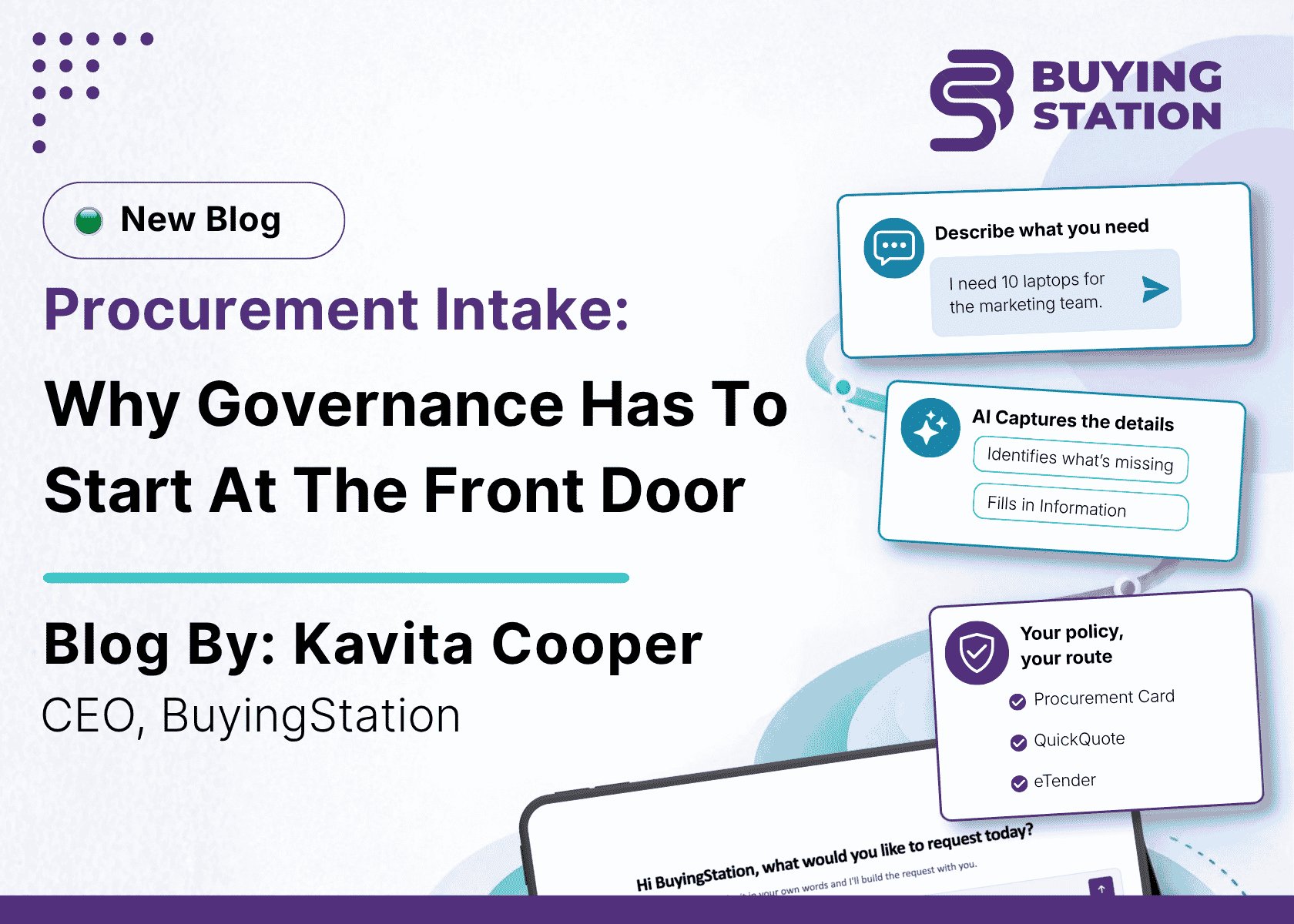
Intake Orchestration changes that process. The requester explains what they need in plain language and the platform guides them towards the appropriate procurement route, using the organisation’s own policy and thresholds. The decision about how the requirement should be handled is no longer left to the requester alone.
Neither outcome shows up in the board pack until much later, usually as a variance nobody can fully explain, a contract nobody can find or a supplier nobody approved.
For a CFO, this is not an administrative irritation. It is a control gap at the very point where commitments are made.
The false choice between easy and controlled
For years, procurement leaders have been told they must pick a side. Make buying easy and accept that some spend will escape the rules or make it controlled and accept that the business will see procurement as the department that slows everything down. I have never accepted that trade-off and I do not think CFOs should either.
The shift we have made with BuyingStation Intake Orchestration is to stop asking the requester to understand procurement and start asking procurement to understand the requester. Someone can describe what they need in plain language.
The platform recognises the user input and asks the questions that matter, ensuring the user is guided towards the correct sourcing route. It then presents a complete Request for them to review before anything is submitted.
The organisation’s own Procurement Policy is applied from the first interaction. Value thresholds, category rules, Procurement Card limits, Quick Quote and Tender thresholds and minimum quotation requirements all help determine the appropriate route. Low value, low risk spend is not buried in unnecessary process, while higher value or controlled spend moves into a more structured sourcing route. The policy stops being a document people are expected to remember and becomes part of the journey itself.
Why procurement intake matters to the Office of the CFO
Here is the part I care about most. AI guides the requester, policy governs the route and people make the decision. Every AI assisted Request is reviewed and explicitly confirmed by a person. Once confirmed, it passes through exactly the same validation, numbering and policy controls as a Request entered manually. There is no separate AI workflow running alongside your governance. There is one process, with one audit trail.
That matters to a CFO for very practical reasons. Every Request is recorded. Identity is validated, even for guest requesters who are not full platform users. Policy decisions are logged and approvals are controlled. When the auditors ask why a purchase went the way it did, the answer already exists.
For organisations where procurement serves hundreds or thousands of occasional requesters, this is where most unmanaged spend begins. Guest intake brings those people into a governed process without turning every one of them into a platform user to administer.
Connected, not another standalone tool
Many tools now offer a request form, a workflow or an AI assistant. I would encourage any CFO to look past the interface and ask a harder question: what happens to that request next? An intake tool that sits on its own simply moves the disconnected process one step earlier.
BuyingStation connects intake to the rest of the procurement environment, including Sourcing, Suppliers and Contracts, so the original business need stays linked to every decision that follows. It is also configuration led. Customers set the thresholds, routes and approval rules that reflect their own operating model, without commissioning complex bespoke workflow development. For growing organisations, that means enterprise style procurement control without enterprise style complexity.
Where to start
If you are a CFO, I would suggest one simple exercise this week. Choose three recent high value spend commitments and trace each one back to the first moment someone identified the need. Ask who saw that requirement, which policy applied and where the record sits today. If the answers are unclear, your governance is starting too late.
This is the problem we built Intake Orchestration to solve. I would like to show you how it works and where it fits within everything else BuyingStation does.
Join our live Platform Walkthrough on Tuesday, 20 October at 4:00pm UK time, where we will walk through the whole BuyingStation platform, including Intake Orchestration.
Register for the Platform Walkthrough
Our principle at BuyingStation is simple. AI First. Human Guided. Procurement intake is where that principle matters most, because it is where every commitment begins.